Featured post

Some of Nhongo Safaris Fleet of Open Safari Vehicles

The photo shows some of our fleet of Open Safari Vehicles used while on safari in the Kruger National and Hwange National Parks. These ve...

Showing posts with label lions. Show all posts

Monday, 4 January 2016

On Safari With Curtis From 29 December 2015

29 December 2015

Today all the guests jumped on the truck for an early start and we had a great start with two leopards up in a Marula tree within the first ten minutes.

We had plenty of white rhino sightings the best being a huge territorial male which crossed over the road in front us.

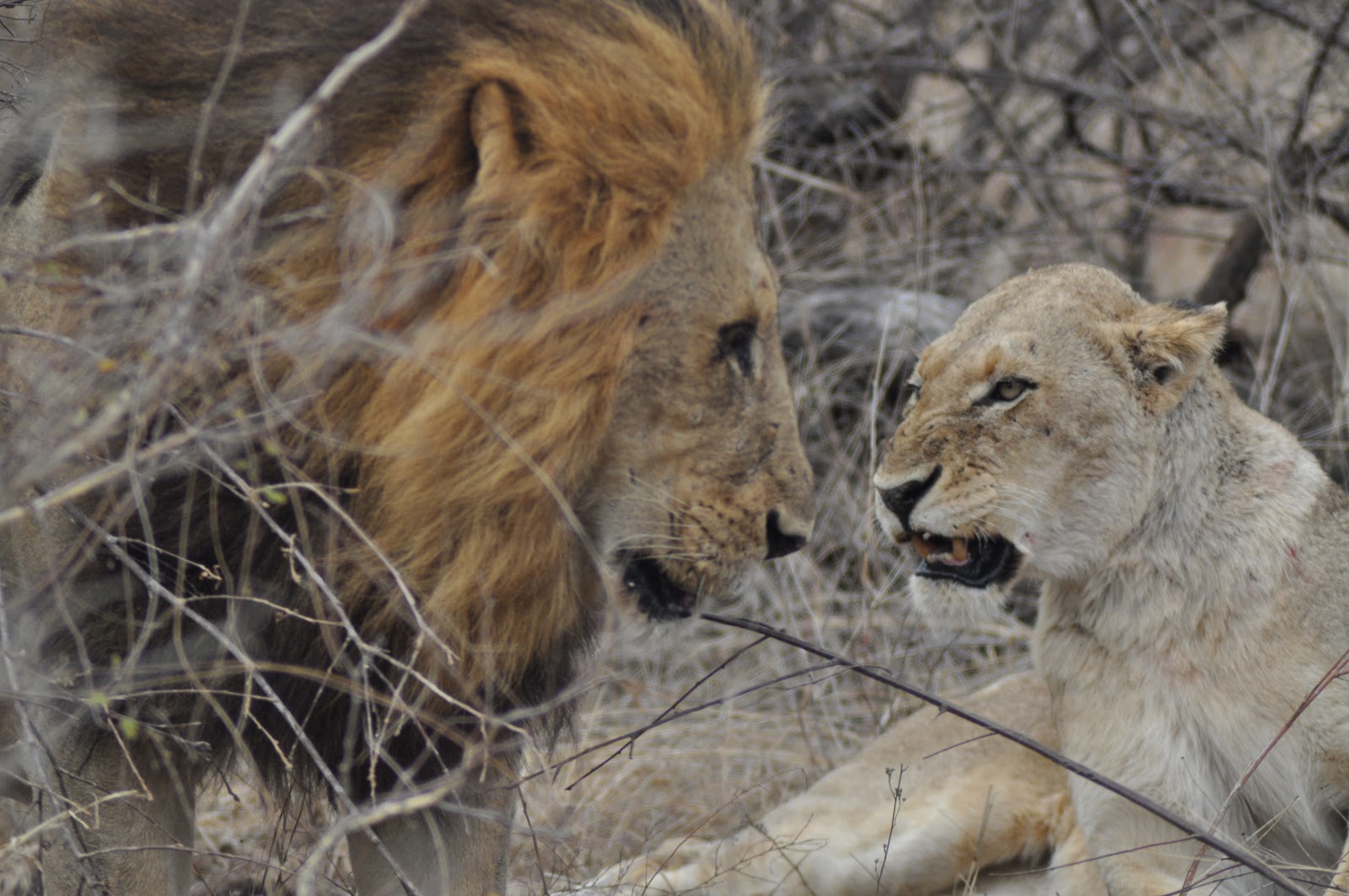
But I think the guests favorite sighting was the lion sighting. We initially found a big male lying in the riverbed taking cover from the increasingly hot sun. With a lot of trees and bush making visibility difficult we moved forward to a much clearer opening and there we spotted another male with two females also in the shade.

As we watched we noticed a herd of elephants which walked right past the bushes and the lions down to the water. They had walked just ten meters from the lions but had missed them, although it certainty got the lions attention. As the elephants drank a second herd did exactly the same, walking past the lions without noticing.

We spent fifteen minutes watching the elephants drinking and splashing about before they moved.

The lions, following the elephants departure, then settled down and relaxed a little bit easier.

Throughout the day we also saw cape buffalo,  Impala, steenbok, giraffe, warthogs, waterbuck, kudu, zebra, wildebeest, klipspringer, hippo, bushbuck, nyala, vervet monkey and baboons.


Birds included goliath heron, fish eagle, woodlands kingfishers, yellow-billed hornbill, marabou storks,  blue waxbill.

30 December 2015

On the final morning of this tour we again split into two groups, a couple of us went for a drive where we saw plenty of elephants including a few very small calves.

We also saw lots of Cape buffalo, zebra, giraffe, kudu, waterbuck, warthog, common duiker, Impala and vervet monkey.

Meanwhile the two girls went out on a bushwalk where they enjoyed learning about the smaller stuff of the Kruger National Park.

They also enjoyed a 200 strong herd of buffalo stampeding, luckily not in their direction, a brief glimpse of hyena and they had a go at tracking leopard!!!

Unfortunately although one of the rangers saw the leopard the guests didn't. But they had great fun!!!

Then farewell time as we said goodbye to Gemma, Hannah and Fabricio who are all exploring more of South Africa.

1 January 2016

The first day of a brand new year and a brand new tour. Joining us today were Barbara and David.

On arriving at Numbi Gate we had time for a drive before heading to the lodge. The drive consisted of a missed leopard and a very nice elephant sighting.

The family herd of about twenty had just enjoyed a nice drink and maybe a swim for a couple of them and now as they walked away from the stream a couple enjoyed a nice dust bath!!!

We also saw zebra, Impala, kudu, waterbuck and warthog for a good start to this safari.

2 January 2016

An early start and a early highlight as, after a tip from Amanda, we found African wild dog!!!

We found just one initially but then spotted a second,  they had caught a baby Impala and although a bit in the bush we could see and hear as their small snack was devoured all within five minutes.

They then decided to walk back onto the road allowing for a much better look. We followed them for a couple of minutes before they sharp turned back into the bush.

Second highlight was a herd of elephants busying destroying a tree in the name of food. We sat watching for about ten minutes when we noticed two more walking towards the herd.

We then looked on the other side of the vehicle and were surprised to not only see a large bull elephant but a white rhino standing watching us and the elephants.

Our attention turned to the rhino and we hoped he would come closer to cross the road but he kept his distance. Nevertheless lovely to see!!!

Also seen were Impala, waterbuck, kudu, crocodile, Vervet monkey, baboon, giraffe, warthogs, common duiker, sable antelope, dwarf mongoose, common reedbuck,  klipspringer, buffalo and hippo.

Birds included the woodlands kingfishers,  lilac breasted roller, tawny eagle, grey heron, cape glossy starling, blacksmith lapwings and goliath heron.

3 January 2016

The highlight of todays drives was the lion sighting. Four lionesses had killed an wildebeest and we arrived to find them lying in the shade digesting their meal.

As is very often with lion sightings you don't get much action but they did occasionally move back to the carcass to eat some more.

Later on we returned to the sighting and found three of them lying next to each other, only awaken by the appearance of a kudu. But they were too full to attempt anything.
When we got bored off looking at the lions we also had two white rhino relaxing on the other side of the road.

As the day warmed up we visited a couple of waterholes. At one we found a small group of buffalo, a small bachelor group of elephant playing in the water, a slightly annoyed hippo, two giraffe, waterbuck and Impala making for a great sighting.

New species also included hyena and steenbok.


Birds seen today included yellow-billed hornbill,  lilac breasted roller, hadeda ibis, egyptian geese and african fish eagle.

Friday, 2 August 2013

Joint Operations Between SANParks And SANDF Making A Difference Against Rhino Poaching

Rhino has cost South Africa a financial loss of about R228 million with the 333 rhinos poached last year alone. These are the statistics according to the Wildlife and Environment Society of South Africa (WESSA); it is for this reason and the need to protect rhinos that the country is going all out to counter poachers.

The deployment of South African National Defence Force (SANDF) members at the Kruger National Park has brought confidence that rhino poaching can be extinguished. The SANDF deployed 265 soldiers at Kruger National Park and the borders around the park in March this year, following a plea for help by the South African National Parks (SANParks).
In an interview with Defence magazine, Colonel Nceba Bobelo, Officer Commanding for Joint Operations Tactical Headquaters in Mpumalanga, said “Operation Corona” was making a huge difference in the fight against poachers. The Army brought in its expertise to beef up a team of Park Rangers, which was overwhelmed by the by increasing killing of rhinos for their horns.

"We've got one Intelligence Tactical Regiment from Potchefstroom, which specialises in intelligence gathering. Special Forces and 21 Batallion, both in the park and on the borders," says Colonel Bobelo. The ground troops are supported by helicopters for a speedy chase of poachers. "The helicopters contribute a lot in terms of identifying areas where poachers are operating," he adds. Colonel Says that it became increasingly important to rope in the army when syndicates began using helicopters, night vision equipment and high-powered rifles in their expedition. The army is part of the National Joint Operational and Intelligence Structure (NATJOINTS), which has role players that include the South African Police Service (SAPS) and SANParks, assisted by the intelligence arms of both the SANDF and the Police. The team also includes the National Prosecuting Authority and magistrates. “We established the joint command centre where we could all meet and share information for planning purposes. The magistrates attend our meetings so that they can understand the important role they need to play in giving rhino poaching cases speedy attention” says Colonel Bobelo.

The Kruger National Park is the country's worst affected by rhino poaching. The annual statistics are always the highest in this internationally' acclaimed tourist destination, with the 2010 figures standing at 146. This environment also makes the park a dangerous place to operate a counter-poaching project from. Colonel Bobelo knows that ail too well: The game is different here at Kruger National Park because the poachers that come from other countries, particularly Mozambique, are armed with AK47s, grenades and axes. They don't play, these poachers mean business" he adds.

Colonel Bobelo confirms that more than 10 suspected poachers had been killed with more than 56 arrested since the SANDF's deployment in this region. The killing of poachers was a result of a shoot-out when the rhino killers attacked SANDF members patrolling the park. Fortunately for the SANDF, the military did not lose a single member in the shoot-out with poachers. Colonel Bobelo says many of the poachers are former Mozambican soldiers and are well trained to fight. Within three months of the SANDF's arrival at the Kruger National Park, rhino poaching cases dropped from 40 in March to just two in June. But poachers always device new strategies and return for more horns.

Rhino poaching is a lucrative business for poachers as one rhino horn translates to around R1 million incomes for poachers. Colonel Bobelo explains: "They move in groups of three. The sniper who's going to shoot the rhino gets R500 000, the one with an axe and the third one get R250 000 each". But is that worth the risk of being killed in a confrontation with the soldiers? Colonel Bobelo says it's because the promise to come back with the rhino horn has got to be fulfilled at all costs. "These people are desperate because we are told they get a deposit from leaders of the syndicates before they carry out the job. Some of the poachers are young unemployed South African men driven by poverty and lured by foreign syndicates to do the dirty job in exchange for attractive amounts of money" adds a concerned Colonel Bobelo.

The biggest focus was on rhino poaching but Colonel Bobelo says, as a result of the military's presence in this area, there has been visible reduction in the crime rate. "We have brought in a big change, not only with poaching, but we have also reduced the illegal trading of goods and illegal crossing at the border," he tells Defence magazine. The South African Constitution stipulates that the SANDF shall protect the territorial integrity and safeguard the sovereignty of the republic. This task was combined with rhino poaching as it also involves illegal activities across the borders. Colonel Bobelo says other crimes such as the smuggling of vehicles and livestock have also decreased.

For operations such as Operation CORONA to be successful, all stakeholders need to buy into the plan and this is what happened with communities that live around the Kruger National Park. “The community is very helpful, we arrested some or the poachers on information we received from members of the community,” says Colonel Bobelo. According to Colonel Bobelo, once soldiers have arrested suspected poachers, they hand them over to the police at Skukuza Police Station based at the Kruger National Park for processes of prosecution to be followed. But before suspects are handed over, members of the SANDF follow procedures of their own. “We take photos of the suspects; photos of their weapons and the rhino horn and then we interrogate them” he adds. The interrogation is led by Park Rangers and members of the SAPS who form part or patrolling teams.

While the SANDF has worked hard to apprehend rhino poachers, the prosecution is often hampered by irregularities in the justice system. “It seems these syndicates have infiltrated our forces” says Colonel Babelo. “Within two months we had over 56 arrests but the dockets got lost. Once the dockets have gone missing the case is over and the suspects are released” he adds in frustration. But Colonel Bolelo says the army will not be discouraged and will continue to use its intelligence arm to counter syndicates and everyone who helps the rhino poachers.

By:
 Department of Defence